Own a Business? Own Your Exit.
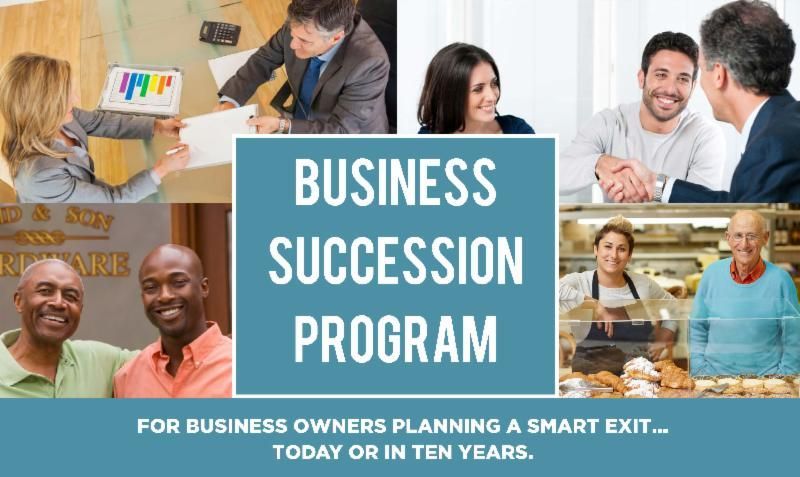
Smart business owners plan their transition from day one…
Whether it’s this year or in ten now is always a good time to prepare your business for your departure. Our region contains a growing number of business owners who are approaching “business exit”, but haven’t yet figured out the strategy t hat best meets their business strategy, financial needs, and personal values. We can help.
How No Deposit Mobile Bonus Regulations in Ireland Differ From Canadian Markets, Explored by Casizoid
The regulatory landscape governing online casino promotions varies considerably between jurisdictions, and few comparisons illustrate this more clearly than the contrast between Ireland and Canada. Both markets have undergone significant structural changes over the past decade, yet the frameworks that govern how operators can advertise and deliver bonus offers — particularly no deposit bonuses on mobile platforms — reflect fundamentally different philosophies about consumer protection, licensing authority, and market competition. Understanding these differences matters not only to operators seeking to enter either market but also to players who may not realise how profoundly jurisdiction shapes what they are actually entitled to receive and how those offers must be disclosed.
The Irish Regulatory Framework and the Role of the Gambling Regulation Act 2024
Ireland spent many years operating under the Gaming and Lotteries Act of 1956, a piece of legislation so outdated that it predated the internet entirely. The country’s online gambling sector functioned in a legal grey area for much of the 2000s and 2010s, with operators largely licensed in Malta, Gibraltar, or the Isle of Man serving Irish customers without any domestic licensing requirement. This changed substantially with the passage of the Gambling Regulation Act 2024, which established the Gambling Regulatory Authority of Ireland (GRAI) as the dedicated supervisory body. The GRAI is tasked with issuing licences to operators targeting Irish residents, enforcing responsible gambling standards, and — critically — setting rules around how promotional offers can be structured and communicated.
Under the 2024 framework, bonus advertising is subject to strict transparency requirements. Operators must display wagering requirements, eligibility conditions, and time limits clearly before a player opts into any promotion. This applies with particular force to no deposit offers, which historically attracted regulatory concern because their apparent simplicity — “receive funds without depositing” — often masked complex withdrawal conditions. The GRAI requires that any bonus terms be presented in plain language, and there are ongoing consultations about whether certain wagering multipliers above a defined threshold should be prohibited outright. Advertising restrictions introduced alongside the Act also limit the hours during which gambling promotions can be broadcast on television and radio, and similar restrictions are being extended to digital channels including mobile display advertising. For players and researchers tracking no deposit mobile casino bonuses in Ireland, the post-2024 environment represents a markedly more structured market than what existed even five years ago, with operator compliance obligations that directly affect which bonus products can be offered and how they must be presented on mobile interfaces.
The practical effect on mobile platforms is significant. Because Irish-licensed operators must now meet GRAI standards, bonus landing pages on mobile apps and mobile-optimised sites must include layered disclosure — a summary of key terms visible immediately, with full terms accessible within one tap. No deposit bonuses, in particular, must not be advertised in a way that implies guaranteed withdrawable cash, a practice that some offshore operators had used to attract Irish players before domestic licensing became enforceable.
How Canadian Provincial Licensing Creates a Fragmented Bonus Market
Canada operates under a fundamentally different constitutional structure, and this shapes its gambling regulation in ways that have no direct parallel in Ireland. Gambling in Canada falls under provincial jurisdiction by virtue of the Criminal Code of Canada, specifically amendments that have allowed provinces to conduct and manage gaming within their borders since 1969. This means there is no single national gambling regulator equivalent to the GRAI. Instead, each province operates its own regime, and the rules governing bonus offers — including no deposit mobile promotions — differ from one province to the next.
Ontario is the most commercially significant example. In April 2022, iGaming Ontario launched as a subsidiary of the Alcohol and Gaming Commission of Ontario (AGCO), creating the first regulated private operator market in Canada. Before this, Ontario residents could legally access only the provincially operated OLG platform for online casino gaming. The opening of the Ontario market to private operators brought with it the AGCO’s Registrar’s Standards for Internet Gaming, which include specific provisions about bonus advertising. Under these standards, operators must not make bonus offers contingent on deposit amounts in a way that pressures players, must display all material terms upfront, and must ensure that promotional content is not targeted at self-excluded individuals. Wagering requirements must be clearly stated, and the AGCO has taken enforcement action against operators who buried these conditions in footnotes or presented no deposit offers in misleading ways.
Outside Ontario, the picture is more complex. Provinces like British Columbia and Quebec operate government-run platforms (PlayNow and Espace-jeux respectively) that set their own internal bonus policies, while residents of provinces without regulated private markets can still access offshore sites operating without provincial licences. This means a player in Alberta faces a completely different regulatory environment than a player in Ontario, and neither faces the same environment as a player in Ireland. Casizoid, which tracks regulatory developments across multiple jurisdictions, has noted that this fragmentation makes it difficult for operators to deploy uniform mobile bonus strategies across Canada — a challenge that does not arise in the same way in Ireland, where a single national authority is progressively consolidating oversight.
Key Structural Differences in Bonus Compliance Obligations
When comparing the two markets at a compliance level, several structural differences stand out. First, Ireland’s approach under the GRAI is centralised and national, meaning an operator with a single Irish licence must meet one consistent standard for all Irish-resident players regardless of where in the country they are located. Canada’s provincial model means that an operator holding an Ontario licence through iGaming Ontario is compliant in Ontario but has no regulated status in British Columbia or Manitoba. For mobile bonus campaigns, this requires Canadian operators to implement geolocation-based segmentation of their promotional content — a technical and legal overhead that Irish-market operators do not face to the same degree.
Second, the treatment of no deposit bonuses specifically reflects different underlying concerns. Irish regulators have focused heavily on the advertising and disclosure side: ensuring players understand what they are receiving before they engage. The GRAI’s approach is partly informed by the UK Gambling Commission’s experience, given the cultural and commercial proximity between the Irish and British markets. The UK introduced tighter bonus advertising rules progressively between 2014 and 2023, and Ireland has adopted several comparable principles. The Ontario AGCO, by contrast, has focused more on the structural fairness of bonus mechanics — the actual wagering requirements and conditions — rather than primarily on advertising presentation. This reflects a different regulatory philosophy, one more focused on the product itself than on how it is communicated.
Third, responsible gambling integration differs. Ireland’s 2024 Act mandates that all bonus offers — including no deposit ones — must be withheld from players who have set deposit limits or who are on the national self-exclusion register being developed under the GRAI’s remit. Ontario has a similar requirement under its iGaming standards, but the technical implementation relies on operators cross-referencing the AGCO’s self-exclusion database. Casizoid’s analysis of both markets suggests that the Irish system, once fully operational, will have a more comprehensive mandatory exclusion mechanism, partly because it is being built from scratch with modern systems rather than retrofitted onto existing infrastructure.
Mobile-Specific Considerations and the Direction of Travel
Mobile platforms have added a layer of complexity to bonus regulation that neither Irish nor Canadian frameworks had fully anticipated when their foundational rules were drafted. The shift toward app-based casino access — accelerated by smartphone penetration rates that exceeded 80 percent of adults in both Ireland and Canada by the early 2020s — means that the majority of no deposit bonus interactions now occur on small screens, often through push notifications or in-app promotional banners rather than through traditional web advertising.
In Ireland, the GRAI’s advertising guidelines are being extended to cover in-app promotional communications, meaning that a push notification offering a no deposit bonus must comply with the same disclosure standards as a banner advertisement on a desktop website. This is a more demanding standard than many operators initially anticipated, and several have had to redesign their mobile CRM systems to include condensed but compliant term summaries within the notification itself. The character limits of push notifications create a genuine technical tension with the requirement for meaningful disclosure, and the GRAI has issued interim guidance acknowledging this while maintaining that the substantive requirement for clarity cannot be waived.
Ontario’s AGCO has taken a somewhat more technology-neutral approach, requiring that operators ensure players can easily access full terms from any promotional touchpoint without specifying exactly how this must be achieved on mobile. This gives operators more flexibility in implementation but also creates more interpretive uncertainty. Casizoid’s comparative research highlights that operators active in both markets tend to adopt the stricter Irish standard across their mobile bonus infrastructure rather than maintaining two separate systems, since building to the higher standard and applying it universally is more efficient than managing jurisdiction-specific mobile experiences.
The divergence between Ireland and Canada in how no deposit mobile bonus regulations are structured reflects broader differences in constitutional design, regulatory history, and the specific consumer protection priorities each jurisdiction has identified as most pressing. Ireland is building a centralised, modern framework that draws heavily on UK precedent and applies nationally, while Canada’s provincial model produces a patchwork of standards that vary significantly even within the country. For players, the Irish system promises more consistency and predictability once the GRAI is fully operational; for operators, the Canadian market offers more commercial flexibility in some provinces but demands more sophisticated compliance infrastructure to navigate. Neither system is inherently superior, but understanding how they differ is essential for any serious analysis of how mobile casino promotions are governed in the English-speaking world.
Want Help?
- Sign up for strictly confidential exit planning consulting: northcoastsbdc.org/join
- If you qualify we will also invite you to sign you up for free access to Mavrek.com, a Special Exit Planning Tool for owners selling within 6-18 months.
- Have your prospective buyers sign up for consulting, too, so your transition and your legacy transfer go smoothly. *We will assign you two separate business consultants and keep an information firewall between the two engagements.
- Watch one or more of the training webinars below.
2020-23 Transition Workshops
Watch the recordings:
- How to Sell Your Business to Your Employees (3/22/2023)
- Going Employee Owned: Retain Talent, Preserve Your Legacy, and See Your Business Thrive (11/5/2021)
- How to Buy a Business – Seven Key Skills and Insights (9/15/2021)
- Employee ownership: protect your legacy even in challenging times (Thriving Together, 8/12/2020)
- Business Exit Strategies – Owner Readiness (Thriving Together, 8/5/2020)
Other Useful Resources
- How to Sell a Business (BizBuySell)
- Request a Free Feasibility Consultation for Employee Ownership Conversion (Project Equity)
- Who Should Own Your Business After You? Why Thousands of Owners Sell to their Employees? (National Center for Employee Ownership)
2019 Business Succession Program
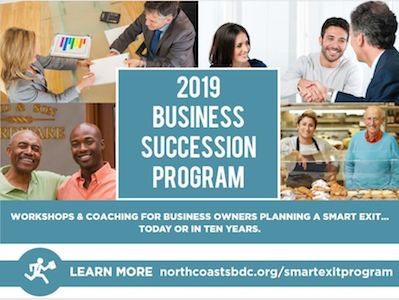
Building on the success of the August 2018 Business Succession Conference, the 2019 Business Succession Program is an interactive, practical guide through your business exit. Best for owners who want intensive, hands-on help to engineer a sound exit in the next 1-10 years. Whether it’s selling to new owners, employees, or transferring to inheritors, this is your springboard to a smart exit. Questions? Contact Center Director Leila Roberts at leila@northcoastsbdc.org or (707) 445-9720 x212
Program Benefits
- Create a strong exit plan that meets both your business goals and family needs.
- Gain confidence that you’re “doing it right” with personalized support from your seasoned SBDC consultant.
- Access best practices from experts who’d otherwise cost you hundreds or thousands of dollars.
How to Participate:
- One-to-one business advising throughout process (sign up to become a client)
- Workshops
- Facilitated Peer Coaching Group
- Speed Consulting with specialists
Workshops
Sign up for one or all the following workshops to help you through the “tricky” parts of selling or transferring your business.
Important for all business owners:
- Simple Steps for Exiting Your Business: Feb 8, 2019 – 10 am to 12:30 pm. Group coaching orientation runs from 9 to 10 am and speed consulting slots are open from 1 to 4 pm
- Your Last Business Plan–Building Strength Before Selling: Fall TBD
Selling the business:
- Valuing & Selling Your Business: March 20th & 27th
- Managing a Strong Transition When Selling Your Business: June 19th
- Negotiating, Structuring and Closing the Deal: Fall 2019
Transferring to family members
Converting to employee ownership:
- Converting Your Business to Employee Ownership–Myths and Realities: Feb 28, 2019 – 5:30 pm. Virtual workshop accessible from your computer or SBDC Conference Room.
- Selling Your Business to Your Employees: Deeper Dive In person workshop, September 23rd
- Lenders and B2B Professionals! Help Your Clients Understand Employee Ownership Conversion. In person briefing September 24th
- Policy makers, economic and community development professionals! Worker Owned Businesses are Growing. Learn Why. In person briefing September 24th
Have a Buyer in Mind?
If you are working with someone (or some people) who would like to buy your business: send them to SBDC. We will also assign your potential buyer a business advisor to help them build a strong business plan, loan application, and more. <b>Important</b> Whenever SBDC is serving both a business seller and buyer we create a strict firewall between the two engagements. Our consultant works for their client’s interests exclusively, and will not
We also offer workships for business purchasers and people new to business:
Facilitated Group Coaching
Respected Humboldt business transition coach Richard Borough is facilitating a peer support process to run in parallel with the Business Succession workshops. This small, private group will gather in between the workshops to help each other stay on track and discuss sensitive topics in a confidential setting.
Participation is free thanks to generous sponsorship from The Headwaters Fund.
Interested?
- Participants must be SBDC clients. Sign up online here or contact SBDC Director to become a client and request your intake interview: Leila Roberts leila@northcoastsbdc.org or (707) 445-9720 x212
- Business owners only.
- Limit of 10 participants in group.
- Come to the first gathering from 9 to 10 am on Friday, Feb 8th to learn more and meet your peers. The group will decide together how often and when to meet thereafter.
Speed Consulting
SBDC also offers “Speed Consulting” appointments with specialists in finance, legal, management. This is an excellent opportunity to bring a concrete question or challenge into a private, one-to-one session and come away with concerete advice. Reserve a spot before or after a workshop, or ask for a virtual consulting appointment: contact Center Director Leila Roberts leila@northcoastsbdc.org or (707) 445-9720 x212
Speed Consulting Opportunities Include
- What drives value in your business? Is your business strong enough to sell for a good price? Consult with Mike Balstad, Regional SBDC Business Succession Specialist
- Is your business right–and ready–for conversion to employee ownership: with Donna Sky or Alison Lingane, Project Equity and SBDC advisors
- Family business and family financial planning aspects of your business exit: with Mike Balstad, Regional SBDC Business Succession Specialist
- The family / personal values and goal-setting aspects of your business exit: with Richard Borough, leadership & transition coach and SBDC advisor
Other speed consulting opportunities come up around new workshops: stay tuned!Q
hand
Sponsored by The Headwaters Fund
Primary funding for the Business Succession Conference and Program thanks to The Headwaters Fund of Humboldt County.
Additional Support From:
And sustaining funding for SBDC from: